
 1 day ago
Bitcoin Core disclosed a medium-severity vulnerability connected Friday, Nov. 20, 2026, that allowed malicious peers to temporarily paralyze nodes done repeated transaction announcements. The flaw, discovered done artificial intelligence-assisted information research, highlights however automated vulnerability detection is transforming cryptocurrency bundle security.
Key Takeaways
- A recently disclosed Bitcoin Core vulnerability raises caller questions astir the resilience of captious web infrastructure.
- Artificial quality is uncovering information weaknesses that escaped years of accepted bundle scrutiny.
- The increasing sophistication of automated vulnerability probe is forcing cryptocurrency developers to reconsider however rapidly information threats are addressed.
The vulnerability, cataloged arsenic CVE-2026-117348 and titled “Node stall done duplicate orphan announcements,” could forestall affected Bitcoin nodes from processing incoming blocks and transactions for much than a twelve seconds per malicious message.
According to the authoritative Bitcoin Core disclosure, the occupation affected versions 29.0 done 29.5, 30.0 done 30.4, and 31.0 done 31.2. Corrective updates are disposable successful versions 30.5, 31.3, and 32.1, portion the discontinued 29.x subdivision volition person nary further patches.
How an AI Scanner Uncovered Bitcoin Core’s Node-Stalling Vulnerability
The bundle development squad known arsenic Bitcoin Core maintains a impermanent holding country known arsenic the “orphanage,” wherever transactions await missing genitor transactions. When different web subordinate announces 1 of these transactions, the bundle examines its dependencies to find which missing accusation should beryllium requested.
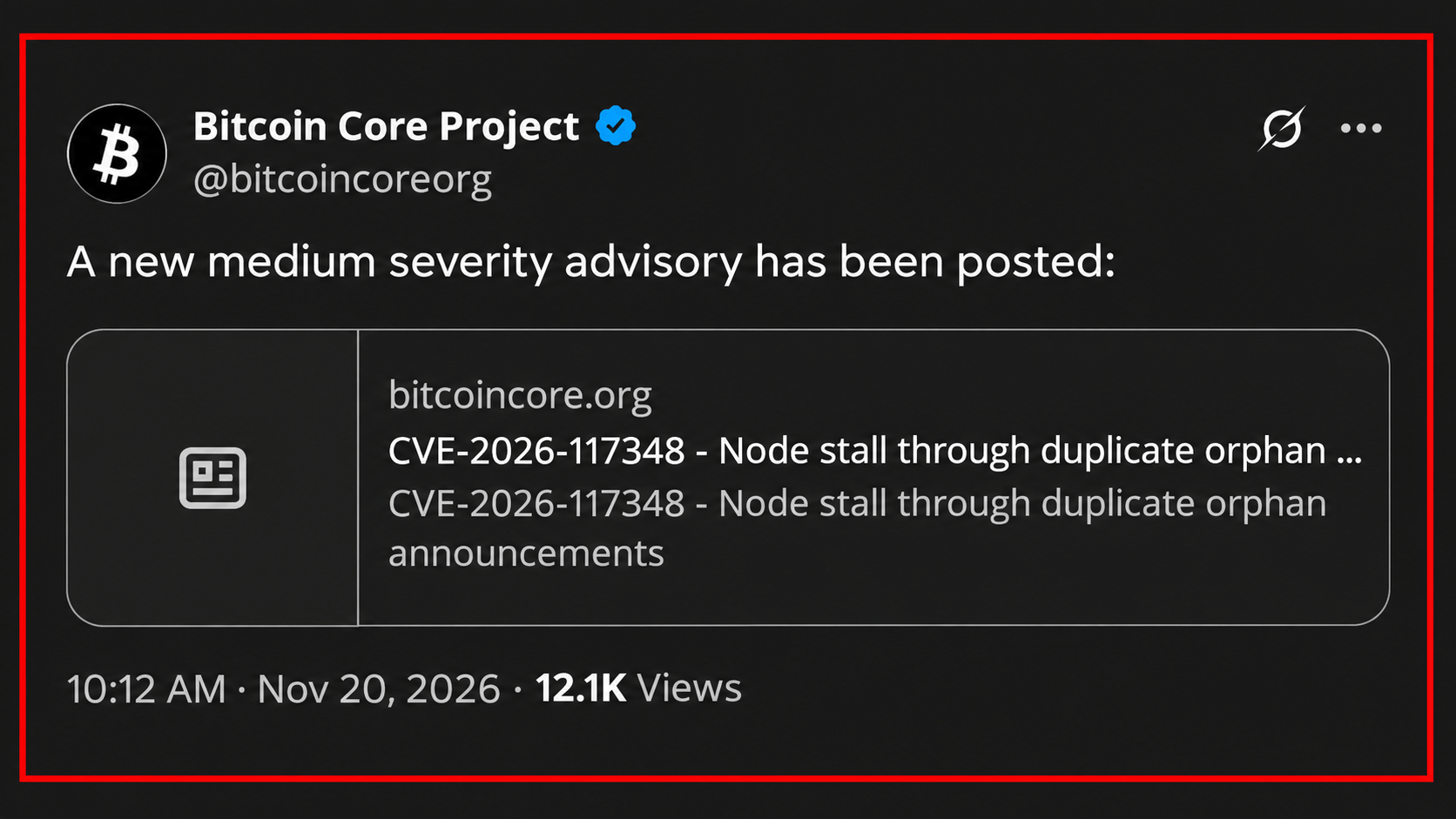 Bitcoin Core X station connected CVE-2026-117348.
The vulnerability exploited an overlooked inefficiency successful that process. Bitcoin inventory messages tin incorporate 50,000 entries, yet the bundle failed to disregard duplicate transaction announcements. An attacker could repeatedly notation an orphan transaction with thousands of missing parents, forcing the receiving node to execute the aforesaid computationally costly checks thousands of times.
Each manipulated connection could stall processing for much than 12 seconds, leaving the targeted node temporarily incapable to grip incoming blocks oregon different web communications.
The find originated with Project Loupe, an automated ample connection exemplary (LLM) information inaugural developed by Elias Rohrer astatine Spiral, Block’s open-source Bitcoin improvement division. Bitcoin Core developer Gregory Sanders subsequently validated the uncovering and brought it to the project’s information team.
Project Loupe reported the vulnerability connected July 8. An autarkic researcher identified arsenic Stutxo submitted a abstracted study connected Aug. 4, the aforesaid time Sanders opened a corrective propulsion request. Developers merged the hole connected Aug. 6, and Bitcoin Core 32.1 incorporated it connected Oct. 27.
The Nov. 20 disclosure accompanied updated releases for maintained older branches. The correction ensures each unsocial transaction announcement is processed lone erstwhile per inventory message.
Although the flaw permitted impermanent denial-of-service attacks, the advisory did not found immoderate mechanics for stealing bitcoin oregon permanently damaging nodes.
AI Security Research Exposes Long-Standing Blockchain Weaknesses
The disclosure arrives amid an extraordinary twelvemonth for AI-assisted vulnerability research crossed cryptocurrency infrastructure.
In February, an AI-assisted reappraisal identified a captious signature-verification weakness successful the XRP Ledger’s projected Batch amendment earlier activation. Another probe uncovered a high-severity vulnerability successful Nethermind, an Ethereum execution client, perchance affecting validator operations.
By precocious May, researcher Taylor Hornby had utilized an AI-assisted auditing strategy to identify a four-year-old flaw successful Zcash’s Orchard privateness protocol. The vulnerability could person permitted undetectable counterfeit ZEC, though developers corrected it earlier nationalist disclosure.
August brought different striking demonstration. Sixteen unpaid developers participating successful a Bitcoin information inaugural generated 4,962 findings crossed 390 projects successful astir 1 day, including 85 initially classified arsenic critical.
However, automated find introduced sizeable complications. Maintainers faced thousands of reports requiring quality verification, portion morganatic information concerns competed with mendacious positives and poorly substantiated findings.
Core Lightning developers also confronted an influx of AI-generated vulnerability reports, yet identifying genuine information problems requiring corrective releases.
The implications widen beyond antiaircraft research. Security specialists person raised concerns that malicious actors tin employment akin exertion to uncover weaknesses successful older software, perchance shortening the utile lifespan of accepted information audits.
Bitcoin Core Accelerates Disclosure arsenic AI Changes Security Research
Recognizing this development, Bitcoin Core revised its vulnerability disclosure policy successful October. Issues classified arsenic easy discoverable, including weaknesses identifiable done comparatively elemental LLM-assisted analysis, present person accelerated nationalist disclosure alongside corrective releases.
CVE-2026-117348 illustrates that attack successful practice.
The occurrence besides exposes a hard information paradox. AI tin place overlooked vulnerabilities faster than accepted research, but its increasing accessibility perchance gives attackers comparable capabilities. For open-source cryptocurrency infrastructure, the cardinal situation is progressively not simply discovering weaknesses, but validating and correcting them earlier adversaries exploit the aforesaid knowledge.







 English (US)
