
 3 months ago
The post Iran Crypto Market Sees 80% Volume Drop After U.S.-Israeli Strikes appeared first on Coinpedia Fintech News
Iran’s cryptocurrency market saw a sharp shock after recent U.S.-Israeli airstrikes, which targeted Tehran, killing its supreme leader. This sent shockwaves through local exchanges as trading volume fell nearly 80% in just two days. Within hours, millions of dollars in digital assets moved out of the country.
While the fighting was military, the financial impact spread quickly into the crypto space. Perhaps the country’s crypto infrastructure remains operational.
Iran’s Crypto Exchange Volume Crashed 80%
Data from blockchain research firm TRM Labs shows that trading volume on Iranian crypto exchanges dropped by nearly 80% between February 27 and March 1.
The sharp fall was mainly linked to the internet blackout imposed after the strikes. With restricted access, many users could not trade normally. At the same time, fear and uncertainty pushed traders to pause activity.
Iran’s central bank also ordered platforms to temporarily stop trading the USDT–toman pair, which connects crypto to the local currency. When trading restarted, liquidity was thin, and prices moved unevenly.
Despite the sudden drop in volume, major exchanges in Iran remain operational in what experts describe as a “risk-managed” mode, with slower withdrawals and tighter controls.
700% Crypto Outflows Signal Capital Flight
While trading slowed, money was moving fast.
Blockchain analytics firm Elliptic recorded a more than 700% jump in crypto outflows from Nobitex, Iran’s largest exchange, within minutes of the first U.S.–Israel strikes.
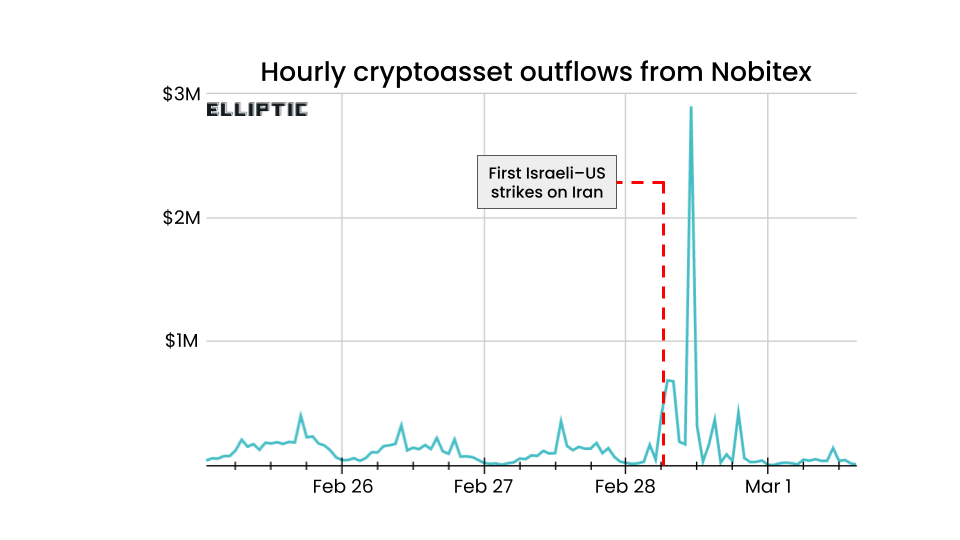
Roughly $3 million in combined inflows and outflows were tracked as users rushed to transfer funds to overseas exchanges. Analysts believe many citizens were trying to protect their savings by shifting assets beyond Iran’s borders.
Despite the sudden drop in volume, major exchanges in Iran remain operational in what experts describe as a “risk-managed” mode — with slower withdrawals and tighter controls.
What This Means for Bitcoin, USDT & Global Exchanges
The Iran conflict shows how quickly crypto reacts to geopolitical stress involving the U.S., Israel, and Iran.
Bitcoin prices briefly dipped after news of the strikes to near $63K before recovering to now $68K. Meanwhile, Stablecoins such as USDT saw increased demand locally as traders looked for safer digital options.
If tensions rise further, more capital could flow through crypto channels, keeping both regional and global markets on alert.







 English (US)